

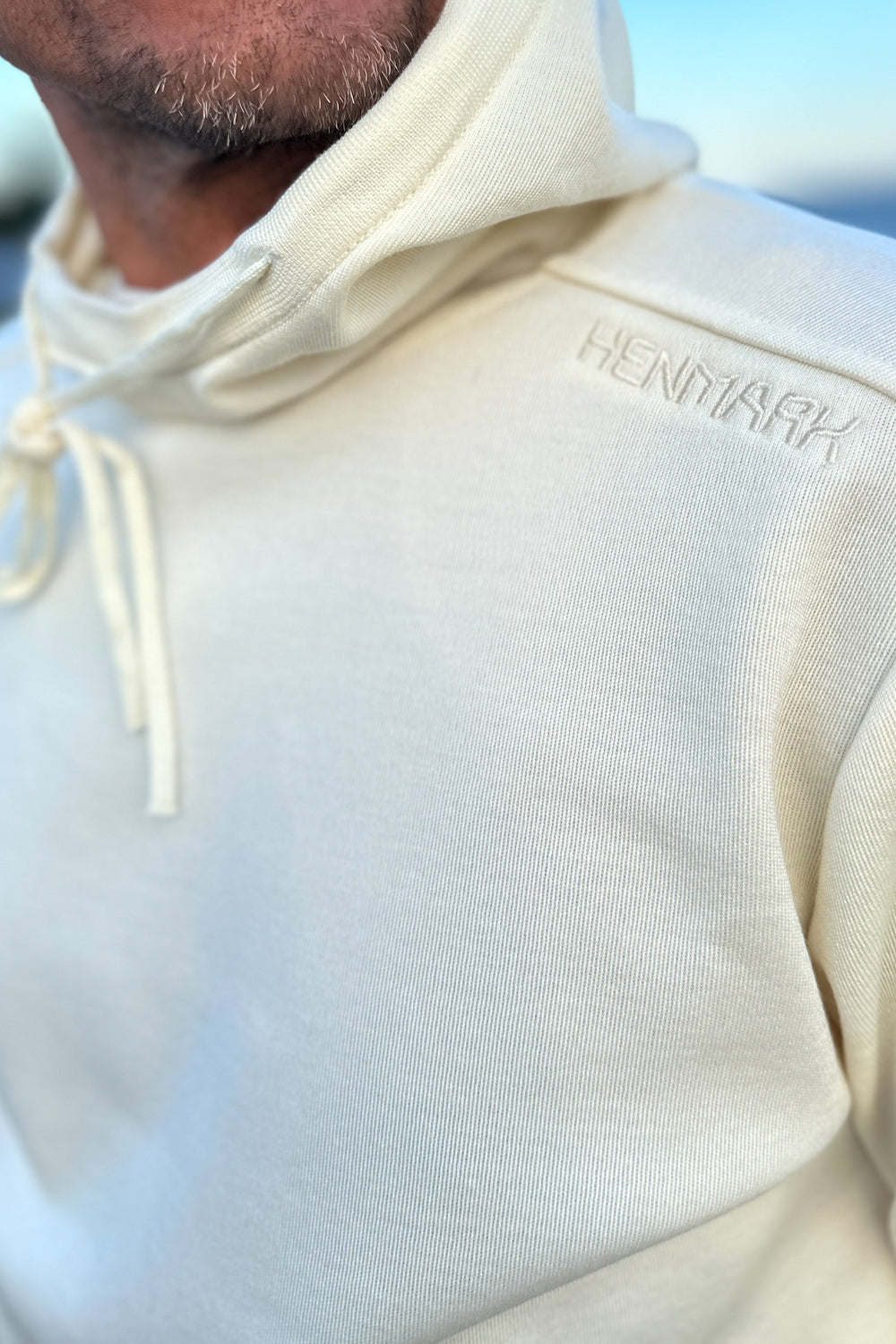
Merino wool
One of our absolute favorite materials. No synthetic material comes close to the properties of soft merino wool. Insulating in cold and cooling in heat. Antibacterial properties that prevent bad odors. Warms even when wet. We use merino wool of thin fiber thickness (low so-called micron value) to maximize comfort when the garments are worn next to the skin.
Merino wool comes from merino sheep, which often live in climates that fluctuate from extreme cold to intense heat. The sheep can withstand winter cold thanks to the wool's warming effect and summer heat thanks to the wool's cooling effect.
The wool's properties also help you maintain a stable body temperature. The very fine and curly fibers create natural air pockets that help insulate against cold, even when the garment is wet. When you get warm during activity, merino wool wicks moisture away from the skin and helps keep you dry. These properties make merino wool a good choice for both warm and cold days.

Soft and non-itchy
The fine fibers of merino wool, combined with its structure, make merino wool garments soft and comfortable to wear next to the body. Unlike coarser wool, merino wool's fine fibers lie flat when they come into contact with the body. So, it would take a lot for you to experience them as itchy.
Naturally antibacterial and odor-free
Merino wool is naturally antibacterial, which means you can wear the same garment for many days without it smelling. Almost a bit magical. Merino wool is therefore an excellent choice for hikes or trips where you want to travel light and perhaps don't have much room for packing.
Warms even when damp
Taking a break in a sweaty cotton shirt is a cold and unpleasant experience. With a wool sweater, it's a completely different matter. That wool warms even when it's wet is an old truth, but why is that?
Wool could be called a smart insulation. The very small air pockets in each wool fiber provide both insulation and breathability. Wool keeps you warm when it's cold, and when it's very hot, it helps keep you cool. It's no coincidence that Bedouins wear thin wool garments in scorching heat.
Merino wool clothing often has a UPF (Ultraviolet Protection Factor) of over 50. It thus provides sun protection that is often higher than cotton and many synthetic materials.
Merino is the most important sheep type for wool production in the world. Merino sheep exist in over 200 breeds and are a type of domestic sheep best known for their wool but also for their meat. Historically, merino sheep originated in North Africa but were brought to both Europe and South America during colonialism. Today, merino sheep can be found almost all over the world.
Australia is the country that produces by far the most merino wool, accounting for over 75% of total world production. Other major producing countries include Argentina, South Africa, New Zealand, and Uruguay.
How much wool a merino sheep produces depends on several factors, such as breed, lineage, sex, and age. Generally, a healthy adult sheep can produce between 3-18 kg of wool per year. The merino sheep's wool grows continuously, so it needs to be shorn at least once a year, otherwise it can cause significant problems for the sheep. It can have difficulty moving, suffer from heatstroke, or cause blindness. The wool produced by each merino sheep is also affected by external factors such as the climate they live in and what they eat. Merino sheep thrive best where they have access to large grazing areas and where they can move freely and have access to food. If food availability is insufficient, it results in extra thin wool.

Mulesing
The merino sheep's very wrinkled skin, combined with the wool on the sheep's hindquarters becoming soiled with feces and urine, creates an environment where blowflies can lay their eggs. The newly hatched larvae then feed by eating the sheep's skin. There is then a risk that the sheep will suffer from a parasitic infection which, if left untreated, can in the worst case lead to the sheep's death.
To prevent flystrike, J.H.W. Mules developed a method in 1929 to prevent flystrike in merino sheep. The method is a surgical procedure performed on lambs when they are between 6-10 weeks old and involves removing the skin folds in the breech area using a mulesing shears or a knife.
Mulesing is normally performed without anesthesia and has shown several negative effects on the lambs. In addition to pain, discomfort, and stress, the lamb's weight gain also decreases for about 14 days after the procedure. There are also other negative effects, such as the lamb being separated from the ewe, and in large herds, the lamb may also have difficulty finding its way back to the ewe because their bleating is drowned out by the large flock.
In which countries is mulesing performed?
After mulesing was banned in New Zealand in 2018, this procedure is now only performed in Australia. Merino sheep in other parts of the world, such as South Africa, Argentina, and Uruguay, live in a climate where the risk of flystrike is significantly lower and where mulesing therefore does not need to be used.
Why is mulesing still performed in Australia?
Mulesing was supposed to have ceased in Australia by 2010, but this has not happened. Attempts have been made with alternative methods, such as non-surgical mulesing where plastic clips are attached around the skin fold, thereby cutting off the blood supply. This causes necrosis, which leads to the skin falling off. Another alternative method is to inject chemicals into the skin. However, neither of these alternatives has proven to be less painful for the sheep and are not accepted as alternatives by Animals Australia, Australia's national animal welfare organization. The only sustainable alternative would be to genetically breed sheep with smooth, wool-free hindquarters that would be resistant to flystrike. This is a long process, and therefore mulesing is still used.
How common is mulesing in Australia?
Unfortunately, mulesing is still very common in Australia. According to the " Department of Primary Industries and Regional Development in Western Australia", the method is still used on more than 70% of all merino lambs. This means that the majority of all merino sheep still undergo this agonizing and painful method because Australia produces 75% of all merino wool in the world.
Is it possible to buy mulesing-free merino wool?
Many companies in the clothing industry have long worked to exclusively buy mulesing-free wool, but this has proven challenging. A large part of the challenge lies in achieving transparency and traceability in the supply chain. Wool is traditionally purchased at large auctions. From the auctions, the wool moves further down the supply chain to be cleaned, carded, combed, and then spun into yarn. The yarn is then knitted or woven into a final garment. There are thus many companies involved in the entire supply chain and many people involved in the different stages.
To further complicate the process, it is very common for merino wool to be blended with different qualities, where the different qualities may not come from just one farm.
Several initiatives aim to ensure animal welfare in the wool industry and enable clothing producers to purchase wool that is guaranteed mulesing-free. However, for larger clothing producers who need large volumes of wool, it can be challenging to find mulesing-free wool in sufficient quantities.
How do we at Henmark ensure that you get mulesing-free merino wool?
To ensure that the sheep that provided the wool for your clothes have not been subjected to mulesing, we, as a supplier, must be able to trace the wool from the sheep farm to the finished garment.
At Henmark, we always strive to have full control over the supply chain for all wool used in our production. Currently, we use certified wool from NATIVA™ for all merino garments, except one. For the W Merino FZ Sweater in 100% merino wool, we use regular RWS-certified wool. RWS means that the wool comes from certified farms, which, for example, guarantee 100% mulesing-free merino wool. RWS-certified merino wool does not allow us to trace the individual farm.
Nativa-certified wool means that, with the help of blockchain technology, we can trace the merino wool from the individual farm until it arrives at our facility. Traceable wool, in short!